
Market Info & Updates

Topics: ERCOT
Industries: All industries
The entire mid-continent is bracing for an historic cold weather event over the next several days. In Texas, energy regulators, delivery utilities, and market participants are making advanced plans to keep the population safe and warm throughout this event. What's in store is not only an energy market issue but also a public safety concern as well. It goes without saying that electric power is a critical service in our modern lives and we should all take precautions against extended power outages over the next few days.
The near-term weather forecast in Texas is the coldest it's been in decades. The forecasted highs and lows for Monday and Tuesday could set numerous “all-time” lows across many portions of the state. These temperatures are likely to be 10ºF to 15ºF colder than February 2011, when ERCOT was forced to deploy rolling blackouts across the state to stabilize the grid.

Source: Amperon
Atmos (the gas delivery utility for most of north and central Texas) has already contacted their industrial customers and have forced curtailments to preserve natural gas pressures for residential and commercial use. This is an important development that illustrates how the state has adapted to extreme weather events over time. During the February 2011 event, several thermal generators tripped offline due to the extreme temperatures. Then, once the blackouts started, many natural gas compressor stations lost power, which further compounded the electric reliability issue by choking off the fuel supply that feeds these power generators.
The good news is that over the past 10 years, the PUCT and ERCOT have worked with power generators to shore up their cold weather procedures while also upgrading the physical infrastructure at these plants, including additional insulation around critical sensors and areas sensitive to cold temperatures like water supply lines. ERCOT also worked with transmission providers to ensure that power to natural gas compressing stations is not cut during emergency conditions.
There is another bit of good news that should help as well. Strong wind production is forecasted in ERCOT throughout this event. In the chart below, we see that greater than 40% of Texas wind resources are expected to be on-line during the worst of the cold, which should dampen any real-time spot market risk and reduce some grid reliability concerns.

Source: Amperon
Ice on wind turbine blades, however, is a potential issue. We've seen in the recent past how ice causes outages at wind farms, starving the grid of electricity when it's needed most. With this storm, current forecasts expect freezing rain to fall in exactly the same areas where our wind resources are installed. De-icing systems are in place on modern wind facilities, but many of the older wind farms are not equipped and will shut down should icy conditions exist.

Source: Energy Information Administration (EIA)

Source: Enverus
ERCOT is already forecasting load for Monday morning through Thursday morning near the all-time ERCOT peak of 74,800 set in August, 2019. In other words, Texas may use more electricity over the coming days than its used on even the hottest days of summer. ERCOT as a winter-peaking system? Wow.
With such little margin for error, we feel it is prudent to prepare for real-time spot electricity prices at or near the $9,000 cap for multiple hours, for Demand Response programs to be deployed, and for the possibility of rolling blackouts. For clients in Texas, now is the time to fuel your vehicle, charge your batteries, and pull out your ski clothes.

 Nov. 17, 2026
What El Niño and LNG costs could mean for winter energy prices
 Oct. 9, 2026
Winter 2026-27 Outlook for Gas and Power Markets: 5 Things to Know from our Live With 5
 Sept. 10, 2026
Buy or Wait? Why Waiting is Also an Energy Buying Strategy
 Sept. 10, 2026
New Rules, New Developments: An Update on Data Center Regulation
 July 31, 2026
5 Things to Know From Our Webinar "How Data Center Growth is Reshaping Power Markets"
 June 29, 2026
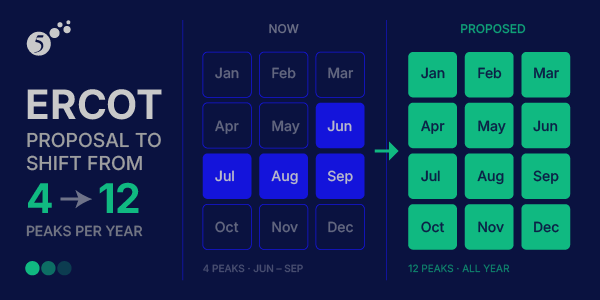
ERCOT Market 3X-ing Coincident Peak Method, Moving from 4CP to 12CP
 May 20, 2026
5 Key Takeaways from Our "Navigating Energy Markets and the Middle East Conflict" Webinar
 April 27, 2026
What the Middle East Conflict Means for Energy Markets
 April 14, 2026
Coincidental Peak Alerts
 Feb. 24, 2026
Stress Test: How Winter Storm Fern Moved Energy Markets
 Feb. 24, 2026
Watts Next? 2025 Lessons and 2026 Predictions
 Jan. 22, 2026
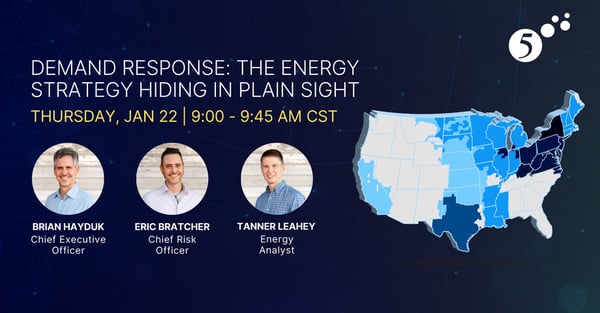
Webinar Recording: “Demand Response: The Energy Strategy Hiding in Plain Sight"