
Market Info & Updates


Topics: ERCOT
Industries: All industries

After Winter Storm Uri in February 2021, the Texas legislatures passed Senate Bill 3, which includes provisions intended to improve the reliability of the grid. One specific portion of this law in Section 18(3) calls for the competitive procurement of additional ancillary services to ensure there is enough electricity supply to keep up with demand during future severe winter weather events.
The Public Utility Commission ordered ERCOT to develop a “firm-fuel” product that would improve grid stability by procuring 3,000 to 4,000 MW of capacity from generation resources that do not depend on natural gas delivered through pipelines. The intent of this provision of the law is to ensure that a certain amount of additional deployable generation capacity can operate even during times of low natural gas pressure in the state’s pipeline system. This new ancillary service is known as Firm Fuel Supply Service (FFSS). The provision required the procurement of this additional reserve capacity to not exceed $54 million and covers the period from November 15 through March 15. In all, 2,941 MW of generation capacity was procured from 19 different generation assets across the state at a total cost of $52.9 million.
Eighteen of the nineteen assets that cleared the auction will use fuel oil (diesel) as the backup fuel source with only one asset relying on onsite natural gas storage capabilities. It is interesting to note that 77% of this capacity is from older, inefficient steam turbine power plants built between 1958 and 1978. These assets use steam, produced from boilers to spin the turbine blades which produce electricity. The remaining 23% of the FFSS capacity was procured from generators that entered service after 1988. These “newer” plants burn fuel in large gas turbine engines, similar to marine turbine generators used in naval and commercial vessels. These engines can run on natural gas, jet fuel, or diesel. A summary of the generating assets procured through this inaugural FFSS auction is shown in Figure 1.
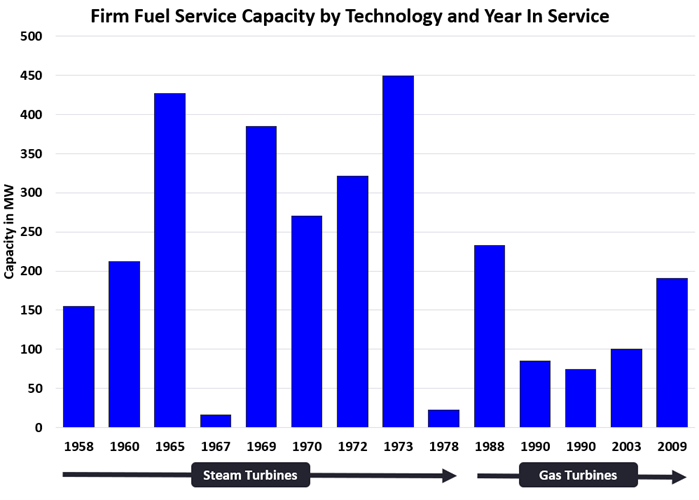
Figure 1: FFSS Capacity by Year by Technology
While the procurement of this service was just below the minimum of the desired range (3,000 to 4,000 MW) and cleared at near the maximum budgeted amount, this additional firm capacity should be enough to power around 500,000 electrically heated residential homes during the coldest days of a typical winter, or about 300,000 homes during periods of extremely cold winter weather such as those during the coldest days in the winters of 1989 and 2021.
Suppliers of retail power in Texas are determining how to account for the additional cost of this new ancillary service. The $53 million dollars spent on this FFSS service auction equates to just under $0.50 per MWh of forecasted load from November through March. Given the protected nature of residential and small commercial customers in Texas, large commercial customers will likely absorb these additional costs, which will be passed through as additional line items on invoices this winter. Large commercial clients should expect an additional charge of about $0.0005 per kWh on monthly invoices from November through March.

 Oct. 9, 2026
Winter 2026-27 Outlook for Gas and Power Markets: 5 Things to Know from our Live With 5
 Sept. 10, 2026
Buy or Wait? Why Waiting is Also an Energy Buying Strategy
 Sept. 10, 2026
New Rules, New Developments: An Update on Data Center Regulation
 July 31, 2026
5 Things to Know From Our Webinar "How Data Center Growth is Reshaping Power Markets"
 June 29, 2026
ERCOT Market 3X-ing Coincident Peak Method, Moving from 4CP to 12CP
 May 20, 2026
5 Key Takeaways from Our "Navigating Energy Markets and the Middle East Conflict" Webinar
 April 27, 2026
What the Middle East Conflict Means for Energy Markets
 April 14, 2026
Coincidental Peak Alerts
 Feb. 24, 2026
Stress Test: How Winter Storm Fern Moved Energy Markets
 Feb. 24, 2026
Watts Next? 2025 Lessons and 2026 Predictions
 Jan. 22, 2026
Webinar Recording: “Demand Response: The Energy Strategy Hiding in Plain Sight"
 Dec. 9, 2025
The Coming Surge: What Large Energy Users Need to Know About 2026 Electricity Prices