
Market Info & Updates

Topics: PJM
Industries: All industries
In New Jersey, similar to neighboring states, larger electricity users (with a peak demand of over 500 kW) are classified as Commercial Industrial Energy Price (CIEP) customers. For these customers, the default utility price is an hourly rate that is an average of hourly prices over the course of a given month. Since these prices change every 15 minutes, there can be a tremendous amount of price risk and volatility with this structure. However, over the last five years, there has not been a significant amount of hourly price volatility. Figure 1 shows the average monthly real-time (hourly) price in the Public Service Enterprise Group (PSEG) zone for each month of the year beginning in January 2015. In New Jersey, and throughout the Northeast, the most volatile times of the year are the winter months of December through March. This is reflected in the chart below with price spikes in January 2018, February 2015, March 2015 and December 2017. It is interesting to note that hourly prices for this winter’s months of January and February are at their five-year lows.
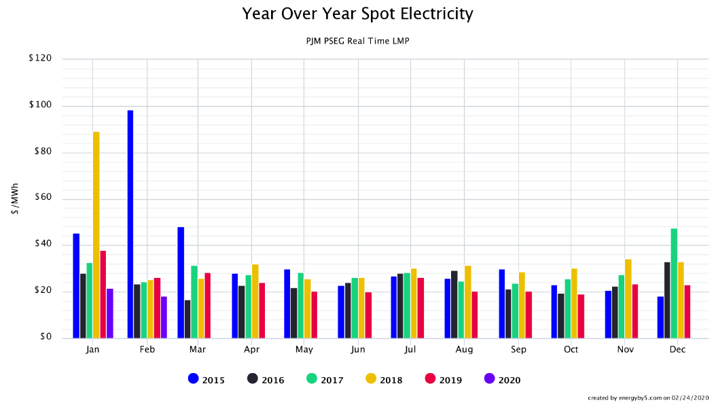 Figure 1: Year Over Year Spot Electricity, by 5
The lack of significant price volatility in PSEG and other PJM markets has created good purchasing opportunities by driving down forward risk premiums. Figure 2 compares forward prices for each month in 2020, 2021, 2022 and 2023 with the five-year historical range for those same months. Note that outside of the winter months, futures prices are trading at a discount to the historical five-year range. And even for the months of December through March, the forwards are trading toward the bottom of that historical trading range. This suggests that the premiums for forwards purchases are not significant. These are strong purchasing signals.
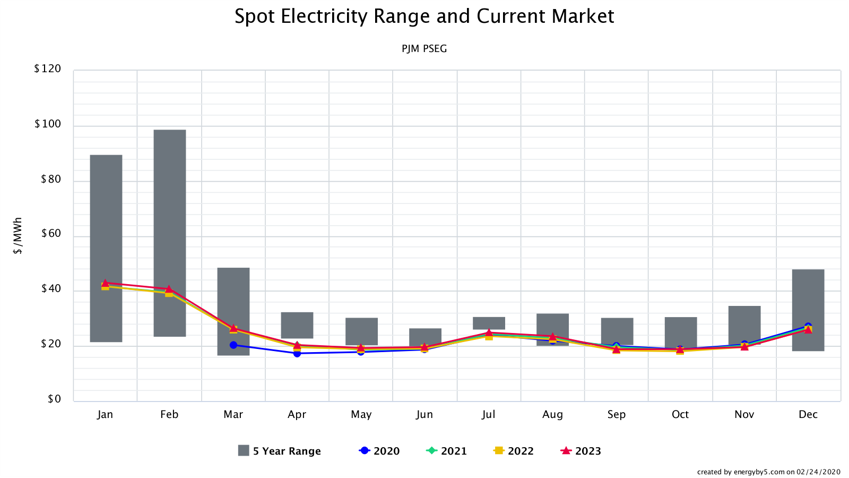 Figure 2: Spot Electricity Range and Current Market, by 5
Good electricity purchasing strategies are determined by comparing risk and reward as opposed to attempting to “time the market” and only make purchases at the bottom. In examining price trends in New Jersey and specifically in PSEG as shown in Figures 1 and 2, there seems to be more upside risk than downside potential. A prudent strategy for CIEP clients in these market conditions would be one that capitalizes on the bearish market trends and attractive forward prices.

 Nov. 17, 2026
What El Niño and LNG costs could mean for winter energy prices
 Nov. 9, 2026
Bring Your Own New Capacity: A New Opportunity for Demand Response
 Nov. 4, 2026
5 Acquires Legacy Energy, Expanding Our Reach in PJM and MISO
 Oct. 9, 2026
Winter 2026-27 Outlook for Gas and Power Markets: 5 Things to Know from our Live With 5
 Sept. 10, 2026
Buy or Wait? Why Waiting is Also an Energy Buying Strategy
 Sept. 10, 2026
New Rules, New Developments: An Update on Data Center Regulation
 July 31, 2026
5 Things to Know From Our Webinar "How Data Center Growth is Reshaping Power Markets"
 May 20, 2026
5 Key Takeaways from Our "Navigating Energy Markets and the Middle East Conflict" Webinar
 April 27, 2026
What the Middle East Conflict Means for Energy Markets
 April 14, 2026
Coincidental Peak Alerts
 Feb. 24, 2026
Stress Test: How Winter Storm Fern Moved Energy Markets
 Feb. 24, 2026
Watts Next? 2025 Lessons and 2026 Predictions