
Market Info & Updates

Industries: All industries
When it comes to energy-related information, utility bills barely scratch the surface. Using them to understand where your budget is going is a bit like trying to read the scoreboard for a sport you don’t understand. But learning how to manage such information can soon have you “batting 1.000”.
To get a grip on what’s happening, smart facility managers may use several types of tools, depending on the data source:
To make sense of monthly data seen on utility bills, energy accounting programs (or services) can be key to discerning trends, finding errors, optimizing tariff rates (where choices exist), and purchasing energy.
To better understand how energy is being used, information from temporary data loggers and permanent monitoring points may be digested by energy analysis programs (or services). They show us details on specific systems, loads, and/or zones. Some energy management and building automation systems (EMS/BAS) collect such data and have built-in trending software.
When considering how a facility’s energy costs are to be managed, it pays to start by looking at the endpoint(s) one wishes to monitor. Is the goal merely tracking pricing and costs – or is there a desire to also control usage and demand?
Some software can do both, but trying to “hit all balls with the same bat” may not be the best way to go. Software that does everything may also be very expensive. One vendor quoted over $200,000 for its product. Fortunately, free (or low-cost) tools exist. Many are available as downloads or are web-based.
To track energy data from utility bills, several online options are available:
– Noesis.com is free, but a bit limited in scope
– EnergyCAPExpress.com, EnergyWatchdog.com, and FacilityDude.com include many more features and are “cloud” based services.
All involve manual data entry, though some have features that accept one or more utility EDI (electronic data interchange) formats to automatically enter billing data.
In-house versions of EnergyCAP and Metrix are available on CD or flash drive but may cost several thousand dollars, depending on which features are included. Utility billing consultants use such software and are happy to quote on annual service contracts that not only handle data collection and input but also identify problems and options with a professional’s eye.
When it comes to energy data analysis, a cornucopia of software (some free, some not) may be found at the US Department of Energy’s Building Energy Software Tools Directory at: http://apps1.eere.energy.gov/buildings/tools_directory/alpha_list.cfm
Tools for all types of analysis are listed and briefly described, including building simulation programs, such as eQuest. When looking for ways to digest energy data, this site is a good place to start.
One free add-in to Excel that is not presently listed at that site is ECAM 2.0 (Energy Charting and Metrics), downloadable at http://www.cacx.org/PIER/ecam/. ECAM handles interval-style data (e.g., hourly, 15-minute) taken from smart utility meters, data loggers, and EMS/BMS. Developed by NorthWrite, a source of many types of non-free energy software, ECAM includes many features found in non-free add-in programs, such as Energy Lens.
The point of such tools is to cut costs by finding saving opportunities: a cheaper rate, a billing error, tuning equipment, or showing the value of an upgrade (e.g., more efficient lighting). Too often, a customer runs up “strikes out” by missing options merely because there was no easy way to identify or value them. But finding an opportunity is like “getting a hit,” and implementing one is always a “score” when it results in both dollar and energy savings.

 Nov. 17, 2026
What El Niño and LNG costs could mean for winter energy prices
 Nov. 17, 2026
California Direct Access: Why the Lowest Electricity Price May Not Be the Best Deal
 Nov. 9, 2026
Bring Your Own New Capacity: A New Opportunity for Demand Response
 Nov. 9, 2026
New SBTi Rules Could Change What You Pay For RECs
 Nov. 4, 2026
5 Acquires Legacy Energy, Expanding Our Reach in PJM and MISO
 Oct. 20, 2026
El Niño: What California Energy Buyers Should Know About Energy Prices
 Oct. 9, 2026
Winter 2026-27 Outlook for Gas and Power Markets: 5 Things to Know from our Live With 5
 Sept. 30, 2026
California’s Electricity Market Is Changing: What Energy Buyers Need to Know About EDAM and Resource Adequacy
 Sept. 10, 2026
Buy or Wait? Why Waiting is Also an Energy Buying Strategy
 Sept. 10, 2026
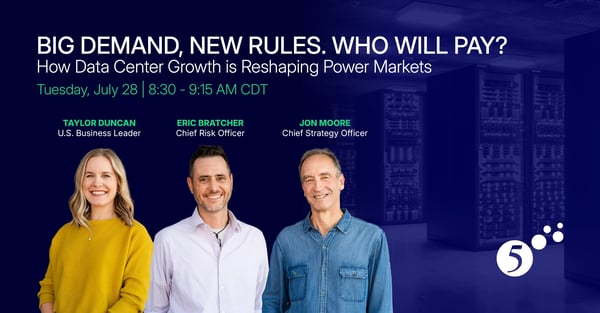
New Rules, New Developments: An Update on Data Center Regulation
 July 31, 2026
5 Things to Know From Our Webinar "How Data Center Growth is Reshaping Power Markets"
 July 24, 2026
Our 8-to-5 Policy