
Market Info & Updates

Despite the name, microgrids are a big deal. In fact, microgrids are a hot topic of conversation lately because of the crucial role they play in business continuity and resiliency planning. Thanks to a handful of unpredictable weather events, a wide variety of stakeholders are turning to microgrids to keep power flowing when natural disasters or catastrophic grid failures disrupt the utility grid’s normal operations.
The best way to understand microgrids is to contrast them to the traditional electric utility’s power generation and delivery systems. Across most of the United States, utility companies move electricity across hundreds of miles of wires that separate the power sources (i.e., power plants) from the end-users of that electricity. Transformers boost the voltage by the thousands of volts necessary to move that power across large distances through the utility’s poles and wires. Despite the fact that wires are good conductors of electricity, the resistance of those wires becomes significant across large distances and contributes to what is known as line-losses.
In contrast, a microgrid is a localized network of generating assets that produce electricity for specific end-use customers. Often, these networks are self-contained and independent systems that serve college campuses, healthcare facilities, municipalities, and military facilities. A diagram of a microgrid and its components is shown below in Figure 1.
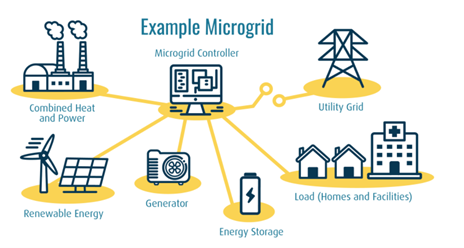 Figure 1: Microgrid Model from naseo.org
There are three essential characteristics of a microgrid.
1. Microgrids are, by definition, a localized system. This means that the users of electricity are geographically close to one another with a specific footprint and defined boundaries. Additionally, the electricity that supplies the microgrid is locally generated and specifically supplies those nearby customers in the system with power. Various types of generating assets can be used in a microgrid such as solar arrays, fuel cells, natural gas generators, and biogas generators. Often battery storage systems play an important role in microgrids as well.
2. Microgrids have advanced control systems. Sophisticated software and systems are necessary to operate, manage and balance the supply of electricity with the demand of the customers in the microgrid. Control systems monitor and adjust the output of the generating assets and coordinate with storage systems to account for the operating profile of the microgrid’s electricity customers.
3. Microgrids can operate independently from the utility grid. A microgrid will maintain electricity supply even if the utility power grid fails. The ability of a microgrid to supply electricity and operate independently of a utility provides the reliability that some essential businesses and organizations require. Some microgrids can connect to the local utility grid while others are completely isolated without the capability to interconnect. “Island mode” refers to a microgrid’s ability to disconnect when the utility grid fails. This is also an essential safety feature to protect utility workers from working on energized circuits in the event of a power failure.
Resiliency and protection from power outages are not the only reasons there has been increased interest in microgrids. Some electricity customers are taking greater interest in the source of their electricity supply. For example, Northeastern University has taken steps to build a microgrid that will both provide the reliability it needs and advance the university’s sustainability and carbon neutrality goals. Northeastern’s microgrid will be comprised of a combined heat and power system, thermal supply and battery storage that is coupled with both on and offsite solar arrays. This is just one example of how one organization has become proactive in managing its energy and capitalized on the innovation and opportunities that deregulated energy markets provides.
Microgrids generate cost savings as well. When the utility grid is used less often, especially at times of peak demand, end-users pay less in transmission and distribution costs to the utility. Look at Texas, for example, where the electric commodity is relatively cheap and is expected to get cheaper over time. While the commodity itself is becoming less costly, the transmission and distribution expenses are increasing every year. Many Texas businesses pay as much in transmission and distribution costs to utilities as they do for energy from a power supplier. Microgrids, when designed and operated appropriately, help reduce long-term exposure to these utility-related costs.
Microgrids are anything but a novelty or a fad. Rather, microgrids are a natural evolution of the original monopolized utility structure. Not only are microgrids here to stay, but they will also define what comes next in our future energy state.
Join us for our Microgrid webinar on Friday April 16th at 9:00am ET/8:00am CT.

 Nov. 17, 2026
California Direct Access: Why the Lowest Electricity Price May Not Be the Best Deal
 Nov. 9, 2026
Bring Your Own New Capacity: A New Opportunity for Demand Response
 Nov. 9, 2026
New SBTi Rules Could Change What You Pay For RECs
 June 29, 2026
NYSERDA to hold first pre-sale of Vintage Tier 4 RECs in July
 April 14, 2026
Coincidental Peak Alerts
 Jan. 22, 2026
Webinar Recording: “Demand Response: The Energy Strategy Hiding in Plain Sight"
 Dec. 9, 2025
The Coming Surge: What Large Energy Users Need to Know About 2026 Electricity Prices
 Dec. 5, 2025
Demand Response: Turning Grid Stress into Opportunity
 July 7, 2025
Market alert: Understanding the impact of the 2025 reconciliation bill on clean energy projects
 June 25, 2025
What Congress' Reconciliation Bill Means for Renewable Energy Incentives
 June 26, 2024
Level5: A Game Changing Energy Management platform
 May 14, 2024
How to Purchase Power in a Bull Market